Checked by the NaMED editorial team: 8 September 2026. All amounts in the tables are taken from the official faculty pages and include links. Faculties set tuition fees separately for each academic year, so before submitting your application, always verify the figure using the link at the end of the article.
How much does medical education cost in Czechia
In Czech, medicine at a public or state university is free. No tuition is charged for the programme itself if the student studies in a Czech-taught programme within the standard period of study. This rule is the same for Czech and foreign students: nationality does not affect the price, only the language of the programme does.
In English, the same programme costs from roughly 291,000 Kč to 588,000 Kč per year. The degree awarded is still the same. Over six years, the difference reaches roughly 3.5 million Kč.
So the main financial question when applying to medicine in Czechia is not “where is it cheaper to study?”, but “how much does it cost to learn Czech to the level needed to pass the entrance exam?”
Tuition fees at all eight faculties
This is the full table for the eight public medical faculties in Czechia. The left column is the Czech-taught programme, the right column is the same programme in English. The figures were taken from the official faculty pages on 8 September 2026. 1. LF UK, Olomouc and Ostrava set tuition in euro; so that the whole table can be read in one currency, we converted them to crowns at the CNB rate of 24.25 CZK/€ on 10 September 2026 — those amounts are marked with “≈”.
| Faculty | City | In Czech | In English, per year | Dentistry in English |
|---|---|---|---|---|
| 1. LF UK | Prague | Free | ≈ 588,000 Kč | ≈ 588,000 Kč |
| 2. LF UK | Prague, Motol | Free | 420,000 Kč | Programme not offered |
| 3. LF UK | Prague | Free | 420,000 Kč | — |
| LFHK UK | Hradec Králové | Free | 400,000 Kč | 410,000 Kč |
| LFP UK | Pilsen | Free | 390,000 Kč | 390,000 Kč |
| LF MU | Brno | Free | 380,000 Kč | 400,000 Kč |
| LF UP | Olomouc | Free | ≈ 303,000 Kč | ≈ 340,000 Kč |
| LF OU | Ostrava | Free | ≈ 291,000 Kč | Programme not offered |
A dash means the faculty does not publish the figure on a single official page, not that the programme is free. We do not insert estimates from other websites into such places.
Note the range: the most expensive English-taught option is about twice as expensive as the cheapest one, and you still have to pass the entrance exam everywhere. A paid programme does not remove the admissions selection.
Why Czech is free and when that ends
Free tuition is not a benefit for foreigners and not a promotion. It is a rule of the Higher Education Act: a public or state university does not charge tuition for a programme taught in Czech. Nationality does not matter; the language of the programme does.
The rule has a limit that applicants often learn about too late. Study is considered free within the standard length of the programme plus one year. General medicine lasts six years, so the buffer extends through the seventh year inclusive. After that, the university begins charging fees for “longer study”.
The amounts are real. In its dean’s order for 2026/2027, the Faculty of Medicine in Pilsen set the fee for exceeding the standard length in General Medicine at 52,000 Kč for each first six months; for dentistry, it is 65,000 Kč. Other faculties have their own figures of a similar order.
The practical conclusion is simple: free tuition does not remove the need to pass exams on time. That is exactly why it is important to apply with genuine Czech proficiency, not with the bare minimum for the admissions committee. A student who does not understand the lectures loses a year — and with it, free tuition.
Six years of study: the Czech path versus the English one
A yearly figure does a poor job of showing the scale of the decision. General medicine lasts six years, so the full programme has to be calculated as a whole.
| What we compare | Czech-taught programme | English-taught programme |
|---|---|---|
| Fees for 6 years of study | 0 Kč | approximately 1,750,000–3,530,000 Kč depending on the faculty |
| Preparation before admission | Czech language plus biology, chemistry and physics | English language plus subject tests |
| Entrance exam | yes | yes |
| Final title | MUDr. | MUDr. |
| Recognition of the degree in the EU | the same | the same |
| Language of clinical practice in a Czech hospital | Czech | Czech will still be needed |
The last line is the one people write about least often. Even in an English-taught programme, the student works with Czech patients, and after graduation Czech is needed for practice in Czechia anyway. The English route does not eliminate Czech; it only postpones it to a later and more expensive stage.
That is why preparation for a Czech-taught programme pays off faster than any other admissions expense. The one-year turnkey preparation costs less than one month of English-taught study at 1. LF UK.
What free tuition does not cover
Only tuition is free. A family budget still needs to cover:
- Preparation in Czech and the three entrance-exam subjects.
- A fee for each application. The amount varies by faculty and programme language. The exact fees are listed below.
- Recognition of previous education and certified document translations.
- A visa or residence permit and health insurance.
- Living costs: a dormitory or rent, food, transport and study materials.
- Extended-study fees, if the student exceeds the tuition-free period.
Application fees for Czech- and English-taught programmes
| Faculty | Czech-taught programme | English-taught programme |
|---|---|---|
| 1. LF UK | 940 Kč | 285 € |
| 2. LF UK | 940 Kč | 2 500 Kč |
| 3. LF UK | 940 Kč | 940 Kč |
| LFP UK | 940 Kč | 940 Kč |
| LFHK UK | 940 Kč | 2 500 Kč |
| LF MU | 900 Kč | 0 Kč |
| LF UP | 790 Kč | 80 € |
| LF OU | 800 Kč | 2 000 Kč / 80 € |
The amounts apply to the 2026/2027 admissions cycle and one application to one programme. The fee is non-refundable. Assessment of a foreign school certificate, bank charges and agent services are separate. Conditions may differ when applying through an official representative, so check the faculty link before paying.
We deliberately do not publish an average monthly student budget for Prague. Such figures date quickly and depend more on the city and lifestyle than on the university. Pilsen, Hradec Králové, Olomouc and Ostrava generally have lower living costs than Prague.
Scholarships: what really exists
There is no single Czech-wide scholarship for foreign medical students. Support comes through the universities themselves, and the usual types are:
- Merit-based — awarded according to the results of the academic year; the amounts and threshold are set by the faculty.
- Housing — the so-called ubytovací stipendium, available to students who meet the university’s conditions.
- Social — for students in difficult financial circumstances, with supporting documents required.
- For research and mobility — for participation in research and exchange programmes.
A foreign student in a Czech-taught programme usually has the same access to these as a Czech student, if they meet the conditions of the specific university. You should check the scholarship page of the chosen faculty: the rules and amounts differ across the eight faculties and change every year.
We deliberately do not list specific amounts here. A scholarship is a welcome bonus, not the main source of study funding, and it should not be used as the basis for a family budget.
How the eight medical faculties differ
All eight award a comparable medical qualification and the same MUDr. title. They differ in city, size, language programmes and the cost of living around them.
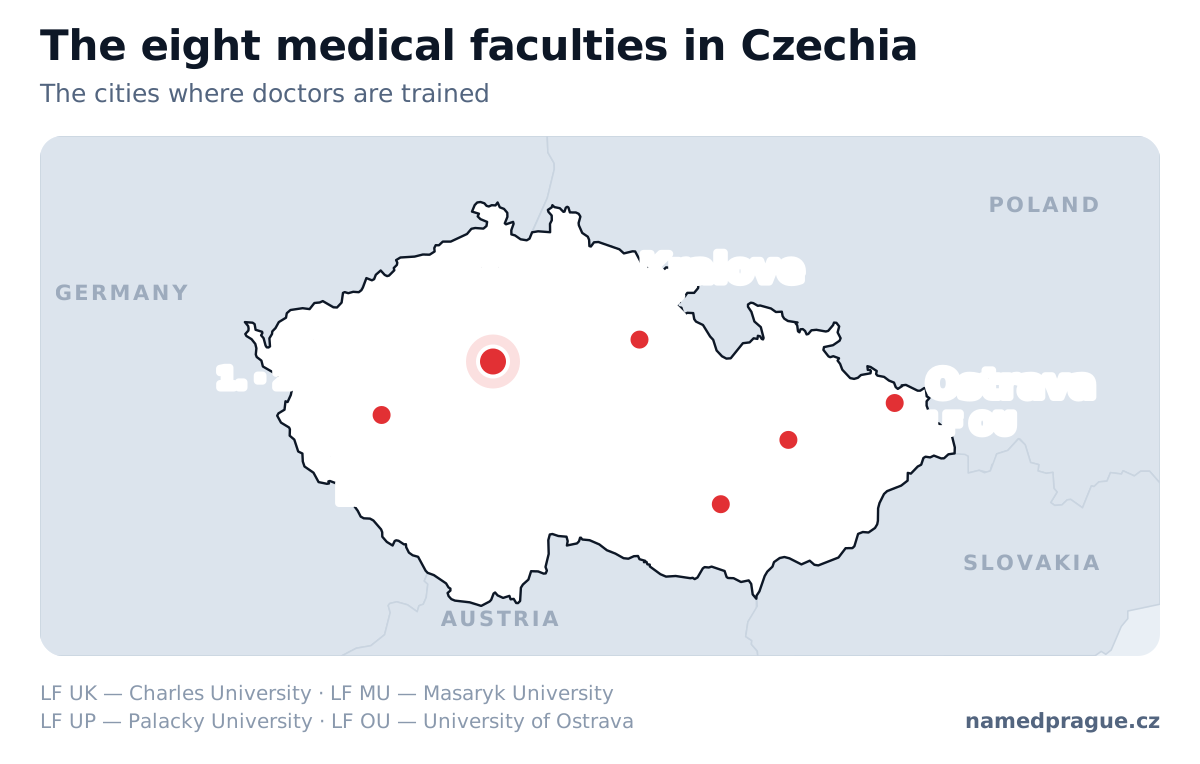
| Faculty | University | City | What stands out |
|---|---|---|---|
| 1. LF UK | Charles University | Prague | The largest intake and the widest choice of clinical placements |
| 2. LF UK | Charles University | Prague, Motol | Strong paediatric tradition, base in the country’s largest hospital |
| 3. LF UK | Charles University | Prague | Integrated teaching and early clinical contact |
| LFP UK | Charles University | Pilsen | New campus, lower cost of living than Prague |
| LFHK UK | Charles University | Hradec Králové | Small intake, calm academic city |
| LF MU | Masaryk University | Brno | Second-largest student city, strong simulation base |
| LF UP | Palacký University | Olomouc | Compact campus, low cost of living |
| LF OU | University of Ostrava | Ostrava | Youngest faculty, most affordable English-taught programme |
The format of the entrance exam, the competition and the chances of admission at each faculty are covered separately: how to choose a medical faculty in Czechia.
Which medical specialisations you can study
The word “medicine” covers programmes with different lengths, different degrees and different prices for the English-taught version. First you choose the profession, then the university.
| Field | Duration | Title | Who it suits |
|---|---|---|---|
| General Medicine | 6 years | MUDr. | For those who want to become doctors and then specialise |
| Dentistry | 5 years | MDDr. | For those who value clinical work and precise manual skills |
| Nursing | Usually 3 years | Bc. | For those who want to enter clinical practice faster |
| Midwifery | Usually 3 years | Bc. | For those choosing to help women during pregnancy and childbirth |
| Physiotherapy | Usually 3 years | Bc. | For those interested in movement, recovery and rehabilitation |
| Nutrition therapy and therapeutic nutrition | Usually 3 years | Bc. | For those who want to work with nutrition in the healthcare system |
General Medicine and Dentistry are continuous master’s programmes. There is no bachelor’s degree in “general medicine” in Czechia, so you cannot apply to become a doctor after a three-year bachelor’s in a related field: it is a separate application to a six-year programme.
What a Czech medical degree gives you
General Medicine ends with the MUDr. title. For independent practice, a graduate continues postgraduate specialisation according to the rules of the country and the profession.
In the European Union, doctors are covered by a system for recognising professional qualifications. A qualification may fall under automatic recognition if it meets the requirements of Directive 2005/36/EC. “Automatic” does not mean “without procedure”: the graduate submits documents to the competent authority in the country, completes the registration requirements and proves language knowledge.
The average monthly salary of a doctor in Czechia in 2024 was 124,775 Kč, including bonuses and allowances; these are data from the Czech Statistical Office. For comparison: the annual fee for the English-taught programme at 1. LF UK is roughly equal to five such monthly salaries.
What this means for a family that watches its budget
Let’s boil it down to one decision. A foreign family has three real scenarios:
- Pay for the English-taught programme. roughly 1,750,000–3,530,000 Kč over six years, the entrance exam is still required, and Czech will still be needed in the clinic.
- Apply to a Czech programme independently. Tuition is free, but preparation happens without a plan: language separately, subjects separately, documents at the last minute. The most common outcome is a lost year.
- One year of preparation, then a free Czech programme. The cost of preparation is the only major expense across all six years of study.
The third scenario is what NaMED has been doing for seven years. One schedule combines Czech, biology, chemistry, physics, mock exams in the format of specific faculties and document checks. You can start with a free assessment: the practice test in three subjects takes 15 minutes and shows your real starting point.
- Turnkey admissions MAX — language, subjects, documents and relocation in one programme.
- Annual course — biology, chemistry and physics for the academic year.
- Czech C1 and interview preparation — for those who are already strong in the subject tests.
Common questions about the cost of medical education in Czechia
Is medical education in Czechia really free?
Yes, if the student studies in a Czech-taught programme at a public or state university within the standard period of study. No tuition is charged for the programme itself, neither for Czechs nor for foreigners. Applications, documents, housing and preparation are paid separately.
How much does medicine in Czechia cost in English?
Roughly 291,000 Kč per year in Ostrava up to 588,000 Kč per year at 1. LF UK. At most faculties the figure falls between 380,000 and 420,000 Kč per academic year. Check the exact amount for your admission year on the page of the chosen faculty.
Is the degree from an English-taught programme different from a Czech-taught one?
No. The title, duration and recognition of the qualification are the same. Only the language of instruction and the cost differ.
Which medical faculty in Czechia is the cheapest for a foreign student?
In Czech, all eight are free, so the question comes down to living costs: Olomouc, Ostrava, Hradec Králové and Pilsen are cheaper than Prague. If we are talking about an English-taught programme, the most affordable is Ostrava at roughly 291,000 Kč per year.
Do you have to pay to submit an application?
Yes. A non-refundable fee is charged for each application to a separate programme. Czech- and English-programme fees may differ: at 1. LF UK they are CZK 940 and EUR 285, while at 2. LF UK they are CZK 940 and CZK 2,500. The full eight-faculty table is above.
Are there scholarships for foreign students?
Universities offer their own forms of support, from merit-based scholarships to social support. The conditions are set by the specific university, and there is no single Czech-wide programme for foreign medical applicants. Check the scholarship page of the chosen faculty.
Can you study medicine in Czechia in Russian?
No. Programmes are taught in Czech or English. Russian may help during preparation, but the entrance exam and study are in the language of the programme.
Is there a bachelor’s degree in general medicine in Czechia?
No. Všeobecné lékařství is a continuous six-year master’s programme. Bachelor’s degrees exist in nursing, physiotherapy, midwifery and other related fields.
How much does a doctor earn in Czechia?
The average monthly salary of a doctor in 2024 was 124,775 Kč, including bonuses and allowances, according to the Czech Statistical Office. The real amount depends on the specialty, experience and region.
Is a Czech medical degree recognised in other EU countries?
In the EU, doctors are covered by the system for recognising professional qualifications under Directive 2005/36/EC. The graduate completes the registration procedure in the specific country and proves language proficiency themself.
What to read next
Official sources
- 1. LF UK — Admissions 2026/2027, tuition fee
- 2. LF UK — Fees and Scholarships
- 3. LF UK — General Medicine, tuition fee
- LFHK UK — Tuition fee 2026/2027
- LFP UK — Admission procedure and fees
- LFP UK — dean’s order 3/2026: tuition fee and fee for exceeding the standard period
- LF MU Brno — Tuition fees
- LF UP Olomouc — General Medicine (MUDr.)
- LF OU Ostrava — General information and tuition fee
- Czech Statistical Office — workers and wages in healthcare
- Your Europe — recognition of regulated professions