Checked by the NaMED editorial team: 8 September 2026. Deadlines, documents, and admissions format change every year; before applying, always verify them on the official page of the specific faculty.
How a foreign student can apply to medicine in Czechia
Applying is not one exam, but six parallel tasks over 9–12 months: choose faculties, have your school leaving certificate recognized, submit a separate application to each university, bring your Czech up to exam level, cover biology, chemistry, and physics, and complete mock tests in the format of the chosen faculty.
The failed scenario is almost always the same: the student studies the subjects, but leaves the documents and language for spring. Then they come to the exam prepared, but with an unrecognized certificate or a missed deadline.
This article is a step-by-step route and calendar. How much studying costs and how the eight faculties differ is covered separately: medical education in Czechia, prices and faculties.
What the application process consists of
The entrance test is only one stage. Before it, the applicant chooses faculties, submits applications, confirms their school education, prepares Czech and the three subject areas. At the same time, they also have to deal with visa matters and relocation. If these tasks do not share one calendar, in spring the documents start taking time away from the final mock tests.
At the start of preparation, write down five things: where you are applying, which subjects and exam format each faculty expects, when the documents will be ready, what your Czech level is now, and where you need a backup option. From this list, you can already build a year-long calendar.
Step 1. Make an admissions plan
First check your level in Czech and the three subjects, count the months until the entrance exams, and clarify the status of your certificate. Then choose several faculties whose format the student can realistically prepare for in time.
- choose medical faculties and backup options;
- compare exam formats and subject combinations;
- assess your level of Czech and medical terminology;
- check which documents and translations will be needed;
- understand where nostrification is required and how long it may take.
Step 2. Documents, visa, and relocation
Translations, recognition of education, university applications, and a visa take weeks, sometimes months. Make a separate document calendar and set a deadline for each step; the last month before the exam should be left for review and mock tests.
Documents are prepared in parallel with biology, chemistry, and physics. Then a successful test does not run into a missed deadline or an unconfirmed certificate.
Step 3. Czech language C1 and medical terminology
Conversational Czech is not enough for a medical faculty. The student will need to read tasks quickly, understand lectures, answer in seminars, and use medical terms. That is why Czech wording should be added to biology, chemistry, and physics from the very first lessons.
You need a separate vocabulary for anatomy, chemistry concepts, biological processes, and problem conditions. A familiar topic should not become new just because the question is written in Czech.
Step 4. Biology, chemistry, and physics
Entrance exams check knowledge, reading speed, attentiveness, and the ability to distinguish between similar answer choices. After each topic block, a short timed test is needed; otherwise, the student learns the topic but does not manage to apply it in the exam.
In biology, check genetics, cell biology, anatomy, and physiology. In chemistry, focus on organic chemistry, reactions, biochemistry, acids, bases, and calculations. In physics, cover mechanics, electricity, thermodynamics, optics, and units of measurement. check the list according to the official syllabus of each faculty.
Step 5. Mock exams and error review
A full mock test should repeat the number of questions, timing, grading rules, and oral part of the chosen faculty. It shows where the student rushes, gets stuck, or loses points on a familiar topic.
After the mock, write down the reason for each mistake: a gap in the topic, an unclear Czech formulation, a calculation error, inattention, or lack of time. The next week of preparation is built around this list.
How preparation works at NaMED
One schedule combines Czech, biology, chemistry, physics, Online Academy, mock exams, and document checks. The student sees the nearest deadlines and knows which result needs improvement before the next mock.
Teachers analyze subject-related mistakes, while the coordinator keeps track of applications, recognition of education, and deadlines. Parents get a clear picture without having to collect the requirements of eight faculties themselves.
Admissions calendar: what to do by month
| 12–9 months before | Choose target faculties, check the exam format, assess your level of Czech, create a study plan, and find out which documents will be needed for recognition of education. |
|---|---|
| 9–6 months before | Build the foundation in biology, chemistry, and physics, start medical terminology in Czech, and prepare translations, certificates, and school documents in parallel. |
| 6–3 months before | Move on to faculty-specific formats: timed tests, tasks with multiple correct answers, interviews, work with popular-science texts if the selected faculty requires it. |
| Last 8 weeks | Write full mock exams, record repeated mistakes, train your answering strategy, check all deadlines, and prepare the final application. |
| After the exam | Follow the results, complete the documents, confirm enrolment, handle visa and practical matters, and prepare for the first semester. |
What exactly are you preparing for
The scale of the exam explains why the route takes a year, not two months. Across the faculties, there are 75 to 150 questions, and only 11% to 30% of applicants are admitted.
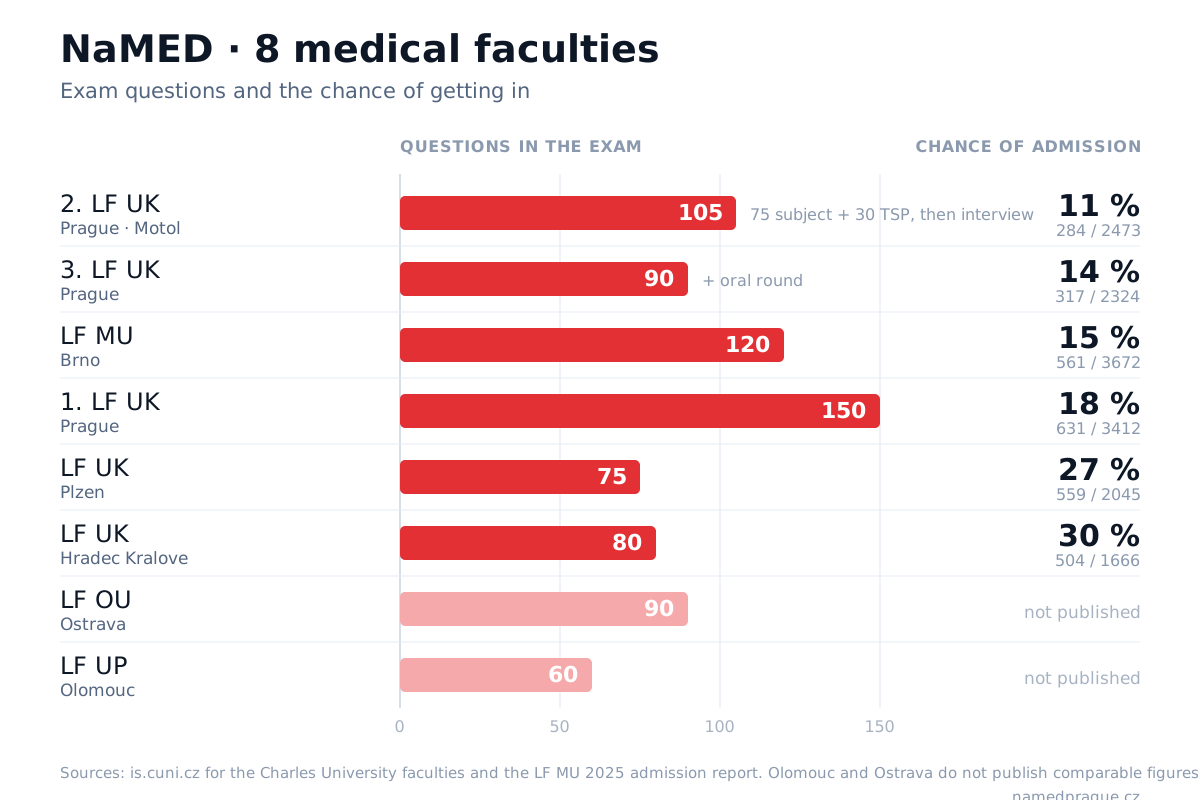
It makes sense to apply to several faculties at once: the formats and dates differ, so one unsuccessful exam does not end the year. Which faculties to choose based on your strengths is covered in the article “How to choose a medical faculty in Czechia”.
Documents: what you must not leave until the last minute
- recognition of foreign secondary education or nostrification, if required by the chosen university;
- official translations of the certificate, transcript, and other school documents;
- proof of Czech language level, if the student is applying to a program taught in Czech;
- electronic applications and administrative fees for each faculty;
- visa, housing, insurance, and a relocation plan if the student is outside Czechia;
- deadline tracking: deadlines and rules may differ by faculty.
Application fees: Czech- and English-taught programmes
The fee is determined by the programme language, not the applicant’s citizenship. An international applicant to a Czech-taught programme pays the Czech-programme fee. If the same applicant submits a separate application to an English-taught programme, the English-programme fee applies.
| Faculty | Czech-taught programme | English-taught programme |
|---|---|---|
| 1. LF UK | 940 Kč | 285 € |
| 2. LF UK | 940 Kč | 2 500 Kč |
| 3. LF UK | 940 Kč | 940 Kč |
| LFP UK | 940 Kč | 940 Kč |
| LFHK UK | 940 Kč | 2 500 Kč |
| LF MU | 900 Kč | 0 Kč |
| LF UP | 790 Kč | 80 € |
| LF OU | 800 Kč | 2 000 Kč / 80 € |
The amounts apply to the 2026/2027 admissions cycle and one application to one programme. The fee is non-refundable. Assessment of a foreign school certificate, bank charges and agent services are paid separately. Open the faculty’s official link in the table before paying.
Certificate recognition: four routes and which one to choose
This is the most underestimated step in the process. You can pass the exam brilliantly and still not be admitted because the certificate was not recognized in time. Czech higher education law allows several ways to prove secondary education, and they differ significantly in cost, timing, and where they are valid afterwards.
| Route | Who it is for | Cost | Where it is valid |
|---|---|---|---|
| General nostrification “Certificate of recognition of equivalence of a foreign school-leaving certificate” | Everyone whose certificate is not on the automatic recognition list | 3,000 Kč to the regional authority or Prague City Hall | Indefinitely and everywhere: any university, employer, or official matter in Czechia |
| Automatic equivalence | School-leaving certificates from Slovakia, Poland, Hungary, and Slovenia | Free | Everywhere, without a separate procedure |
| European or International Baccalaureate (EB, IB Diploma) | Graduates of IB and European schools | Free | Everywhere |
| Faculty assessment (posouzení) | For those who do not have time to go through general nostrification | Paid; at 1. LF UK it is 990 Kč | Only one faculty and only one academic year |
For applicants from Ukraine, Kazakhstan, and other countries outside the automatic recognition list, general nostrification is usually more practical. 1. LF UK recommends this route: one document can support several applications instead of requiring a separate assessment at each faculty.
The procedure takes weeks, and longer if additional documents are requested, so it should be started in autumn, not in spring.
Deadlines you cannot miss
An example of real deadlines at 1. LF UK for the 2026/2027 intake: the electronic application for education assessment must be submitted by 30 June 2026, and the paper originals and certified copies must be sent to the faculty address by 15 July 2026. Anyone who misses this will not be admitted to the first year, regardless of exam results.
Each faculty has its own dates. Check them on the official admissions page at the very start of preparation and add them to your calendar right away.
Translations: where documents are most often rejected
Documents issued in a language other than Czech, Slovak, or English must be translated by a sworn translator. An important detail that trips people up every year: the translation sheet must be bound to a certified copy of the document so that the pages cannot be replaced. A translation bound to an ordinary photocopy will not be accepted.
Another common reason for refusal in faculty assessment: proof of the school’s accreditation must be issued by the higher authority, meaning the Ministry of Education of the country. A certificate from the school itself is not accepted.
What C1 means in practice
The certificate confirms language level, but at the faculty the student needs to read tasks, understand lectures, work through medical terminology, and answer teachers at a working pace. That is why Czech and the subject areas are best prepared together.
If biology, chemistry, and physics are taught with Czech terms from the beginning, the student will recognize the topic immediately in the exam. In a calculation problem, one misunderstood word can change the whole meaning of the task.
Typical applicant mistakes
- Documents in spring. The most expensive mistake in the whole route. Certificate recognition takes weeks, and its deadline comes after the exam, when it is too late to deal with paperwork.
- Faculty assessment instead of nostrification. It seems faster and easier, but it is valid for one faculty and one year. With three applications, that means triple payment and triple paperwork.
- A translation bound to an ordinary copy. A formality that causes the set to be returned and costs two weeks.
- Choosing a faculty by prestige without checking the format. The university name matters, but the exam format matters more for the actual result.
- Leaving physics for later. Many students postpone physics because they dislike it, and then lose decisive points there.
- Preparing without a timer. Knowledge without speed often does not turn into results in medical entrance exams.
- One faculty and no backup plan. Even a strong student may not get in in a given year because of competition, stress, or format.
What happens after the exam
Almost nobody writes about this stage, but it takes another two to three months and has its own deadlines.
- Results and admission decision. The faculty publishes results and sends the decision. Some applicants may have a chance through an appeal or through a place that becomes available after other admitted students decline.
- Submitting additional documents. This is where certificate recognition is completed if it was running in parallel with preparation.
- Enrollment (zápis). In-person attendance on the assigned day with originals. Missing the enrollment date means losing the place.
- Visa or residence permit. Booking a consular appointment takes time, so the slot is reserved immediately after the admission decision, not after enrollment.
- Housing. The dormitory application is submitted in the same weeks: places are assigned before the semester begins.
- Insurance and the first semester. Health insurance, bank account, registration at the place of stay.
For NaMED students, the coordinator handles this block together with the family, so the second round of panic does not begin after the exam.
How much preparation costs
Studying at a medical faculty in Czech is free, so preparation is the only major expense for all six years. The amount is known in advance.
| Year-long courses | NaMED yearly course - 1850 euros, yearly MAX - 2350 euros. Biology, chemistry, and physics for the academic year, Online Academy, and mock exams. |
|---|---|
| Short formats | Half-year course - 1199 euros, intensive course before the exam - 299 euros. |
| Czech language | “Road to C1 + interview” course - 999 euros, if the faculty requires a certificate. |
| “Turnkey” | Subjects together with Czech language and document support - 5500 or 5900 euros. |
After that, only the administrative fee for the electronic application at each faculty and document translations remain. We provide the list of required documents at the start of the academic year, so in spring the student works on mock tests instead of searching for certificates.
For comparison: the same program in English costs from 12,000 to 24,250 euros per year. The full breakdown for all eight faculties is in the article “Medical education in Czechia: how much it costs and where to study”.
Admissions FAQ
How long does preparation take?
It is best to plan for an academic year: about 9 months for the subjects, C1, terminology, mock tests, and documents. Three to five months can also work, but then preparation becomes intensive and riskier.
When should I submit documents?
The application period usually falls in late autumn and winter, but exact dates are different for each faculty and change every year. Check them on the official admissions page of the specific faculty and add them to your calendar right away, not as the deadline approaches.
Do I need nostrification of my certificate?
Recognition of foreign secondary education is required, and the procedure depends on the university and the country where the certificate was issued. It takes weeks, sometimes months, so it cannot be started in spring. Make a document list at the start of the academic year and set a deadline for each step.
Should I apply to several faculties?
Yes, if the goal is to increase your chances of admission. Several faculties give the student more scenarios, but only if they are chosen consciously and preparation takes their different formats into account. The application fee is paid separately at each faculty.
What level of Czech is needed for medicine in Czechia?
For programs taught in Czech, faculties of Charles University require C1 from applicants without a Czech or Slovak maturita. But the certificate is only the minimum. In classes, the student needs to read tasks at exam speed, understand lectures, and answer in seminars, so Czech terminology in biology, chemistry, and physics should be introduced from the first months of preparation.
Can I study medicine in Czechia without knowing Czech?
Yes, for programs taught in English, but they are paid. Free study at public universities is tied to the Czech language, so for most applicants from Ukraine, Kazakhstan, and other countries, the path goes through Czech.
Which faculty is easier to get into?
There is no universal answer, because the format differs. Some have one written test, some have two rounds with an interview, some penalize mistakes or require a minimum threshold in each subject. It is easier where the format matches the student's strengths, not where the competition was lower last year.
What if physics is weak?
Start with it, rather than putting it off. Physics is part of the exams at almost all medical faculties, and it is usually where applicants lose decisive points. Delaying physics is the most common reason why a student who is strong in biology does not pass.
Can I submit documents if my certificate has not been issued yet?
Usually yes: graduates of the current year submit the application, and the education document and its recognition are sent later by the enrollment deadline. The exact procedure and final deadline are set by the faculty, so check its admissions conditions for your intake year.
What does Online Academy offer if the student already studies offline?
It is a database of more than 8,100 sample questions with explanations and more than 200 video lessons in biology, chemistry, and physics. It is needed for repetition volume: one lesson a week gives topic review, but the student has to solve questions and train speed between lessons.
How much does studying medicine in Czechia cost?
In Czech at a state or public university - free. In English - from 12,000 to 24,250 euros per year depending on the faculty. The full table for eight faculties with links to official sources: medical education in Czechia.
Where to start right now
The route looks long, but the first step is short: understand your starting point. You need to know your current Czech level, the real state of biology, chemistry, and physics, the status of your certificate, and the number of months until the exam. From these four numbers, the calendar is built.
Start with a free diagnosis: the mock test in biology, chemistry, and physics takes 15 minutes and shows your real starting point. Then we will look at the deadlines and put together a list of faculties, and if you do not need preparation, we will say so.
- “Turnkey” admission MAX — language, subjects, documents, and relocation in one program.
- Year-long course — biology, chemistry, and physics for the academic year.
- Czech C1 and interview preparation — if the subjects are already strong.
- Mock test — 15 minutes to see your current level in the three subjects.
What to read next
Official sources
Before applying, always check the current academic year on the official faculty websites. For this article, we used the admissions pages of 1. LF UK, 2. LF UK, 3. LF UK, LF UK in Plzeň, LFHK UK, LF OU, LF UPOL, and LF MU.
- 1. LF UK - admissions process
- 2. LF UK - admissions process
- 3. LF UK - admissions process
- LF MU - admissions process
- 1. LF UK - tuition and deadlines for the English program 2026/2027
- 2. LF UK - Fees and Funding
- LF OU - tuition for the English program
- ČSÚ - Workers and wages in healthcare
- 1. LF UK - assessment of foreign education, deadlines, and fees
- Charles University - recognition of foreign education