Reviewed by the NaMED editorial team: 24 August 2026. The comparison is based on the published formats for the 2026/2027 cycle; the conditions for the next intake should be checked again on the official websites.
How to choose a medical faculty in Czechia
Check five parameters: subjects and grading, whether there is an interview, your result on a mock test, Czech language requirements, and the document calendar. Then choose 3–5 faculties: one or two ambitious targets and several options where your current result is already close to the pass mark. Each format needs separate practice.
What to compare besides the name and the city
A well-known name and a convenient city matter, but admission is decided by the specific format. For an international applicant, you need to check the subjects, grading rules, interview, Czech language, documents, and deadlines at the same time.
One student may pass a written test confidently and then freeze at the interview. Another speaks well but loses points in physics. That is why faculties should be compared against the student’s mock test results, not against each other in isolation from the student.
Criterion 1. Entrance exam format
The first thing to compare is which subjects are included in the exam and how the questions are structured. If a student is strong in biology but much weaker in physics, that affects the strategy. If the faculty requires broader preparation, you need to build in more time for weak areas in advance.
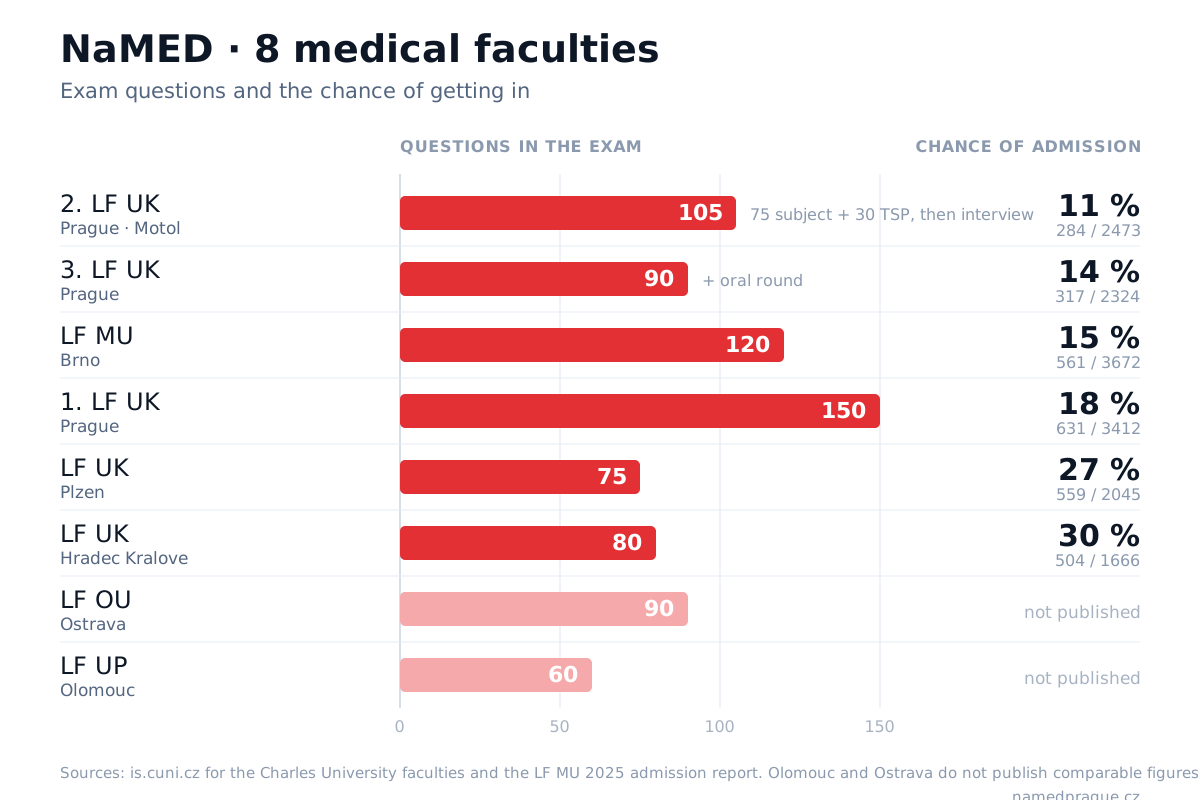
- which subjects are tested in the exam;
- whether there is an oral part, interview, or additional conversation;
- what the test format looks like and how much time is given;
- which topics are most often risky for international students.
Criterion 2. Czech language and academic environment
In a Czech-taught programme, the student reads materials, listens to lectures, answers in seminars, and quickly works through task instructions. A mock test in Czech will show language readiness more accurately than everyday conversation.
If medical terminology is already familiar, you can add faculties with interviews or tighter timing. If Czech is weak, you need to start earlier and not postpone the language until after the subject preparation is finished.
Criterion 3. Documents, nostrification, and deadlines
Faculties differ in application deadlines, fees, the process of recognising education, and the requirements for proving Czech language skills. Alongside your list of faculties, keep a document calendar.
Write down the dates, translations, and confirmations for each application. Before sending anything, open the official page again: requirements change, and last year’s checklist may already be wrong.
Criterion 4. City, adaptation, and everyday reality
Compare housing costs, commute to campus, city size, and available support. Prague offers more options and a faster pace; Plzeň, Hradec Králové, Ostrava, Olomouc, and Brno offer a different cost level and student environment.
The first months of study are hard even without moving. If the student also needs to find housing, sort out documents, and get used to a new city at the same time, that should be taken into account already when choosing the faculty.
Criterion 5. Main target and backup options
Keep the dream faculty on the list, but add several more applications with a suitable format. One bad day, high competition, or a weak oral part should not erase a year of preparation.
A backup faculty also needs preparation: know its topics, timing, documents, and exam date. A random application without separate practice does little to improve the chance of admission.
How NaMED helps choose faculties
We match mock-test results with faculty formats, check the Czech level, deadlines, and documents, and then suggest a list of applications. It shows where a separate block is needed for an interview, somatologie, physics, or test speed.
After the choice is made, the student receives a preparation calendar for each application. This way, one subject foundation works for several faculties, while the differences are trained separately.
Format comparison: what changes between faculties
| 1. LF UK | A classic broad test in biology, chemistry, and physics. Suitable for students ready for high competition and systematic preparation in all three subjects. |
|---|---|
| 2. LF UK | Written part plus an oral stage. Not only subjects matter, but also communication, motivation, working with text, and medical thinking. |
| 3. LF UK | A written test and an interview based on a popular-science text. A good option for students who can reason and speak Czech. |
| Plzeň | A more direct written format without an interview. Requires consistency, accuracy, and good timing across the three subjects. |
| Hradec Králové | A separate somatologie block and a penalty for a wrong answer. Requires a risk strategy and separate work with anatomy and physiology terminology. |
| Ostrava | A computer-based test with minimum thresholds for the total score and individual subjects. It is important not to fail any block. |
| Olomouc | A compact timed test. Mistakes are costly because there are fewer questions and each one affects the result. |
| Brno | Three long subject tests and a strong practical infrastructure. Requires stamina and pace control. |
How to choose 3–5 applications
Start with the main target, then add faculties where the student is already close to the required result or where the format matches their strengths. Biology, chemistry, and physics are prepared together, while interviews, somatologie, penalties, and special timing are added for each specific application.
- One or two ambitious targets: faculties where more improvement is still needed to reach the pass mark.
- Two suitable options: faculties whose format matches the student’s strengths.
- One backup: a faculty with a well-prepared exam and acceptable study conditions.
- Document calendar: deadlines, translations, language confirmation, and recognition of education for each application.
How to tell whether a faculty is right for you
Look at the diagnostic results. If test scores are stable but oral answers are weak, the interview will require separate preparation. If a student speaks confidently and can work with a scientific text, 2. LF or 3. LF may make use of that strength. Weak physics needs to be started earlier regardless of the city.
After the exam, compare the cities: housing, commute, pace of life, and local support. A convenient city matters, but first you need to make sure the student is ready for the admission format.
Faculty selection checklist
- Which subjects are included in the exam and how many questions are there in each?
- Is there an interview, text work, a prerequisite test, or a penalty for mistakes?
- What level of Czech needs to be confirmed, and when?
- What documents does a foreign graduate need, and what are the deadlines for recognition of education?
- How much time is realistically left until the exam, and which subject is currently the weakest?
- Does the student have backup options that they are actually preparing for?
The role of parents in choosing a faculty
Parents can check the budget, housing, safety, documents, and deadlines. The student is left to honestly assess the study pace, the city, and readiness to spend six years at the chosen faculty.
A useful question for a family discussion is: “Where are your chances of admission higher, and where are you ready to study every day?” It gives more than an argument about prestige.
FAQ
Which medical faculty in Czechia is the best?
There is no universal answer. For one student, 1. LF will be best because of the classic programme and Prague; for another, 2. LF because of the clinical profile and interview; for a third, Plzeň, Hradec, Ostrava, Olomouc, or Brno because of the format and adaptation.
Is it worth applying only to Charles University?
Charles University is a strong target, but a strategy with several universities is often wiser. It is important to add faculties outside Charles University not “just in case,” but with an understanding of their format.
Can you choose a faculty after preparation has already started?
Yes, but it is better to put together the basic list at the beginning. Then preparation immediately takes into account the interview, penalties, number of questions, C1, and documents. It is much harder to change the strategy in the spring.
Read detailed breakdowns of the faculties
Official sources
When choosing a faculty, we check the official conditions for the specific year, because the exam format, dates, documents, and rules for bonusových bodů may change.