Reviewed by the NaMED editorial team: 24 August 2026. The plan should be adapted to your starting result and the formats of the selected faculties.
How to prepare for biology, chemistry, and physics without chaos
Start with a diagnostic check of all three subjects. Then work in weekly cycles: topic, short test, review of why mistakes happened, and repetition. 8–12 weeks before the exam, move on to full-length practice tests in the format of the selected faculties. Add Czech terminology from the very first lesson so you do not waste time translating the task wording.
How to connect three subjects with the exam format
Biology, chemistry, and physics require different approaches, but they are tested in one exam period. For each subject, you need a topic list, Czech terms, timed tasks, and an error log. In the exam, the student must quickly recognize the question type and choose the solution method.
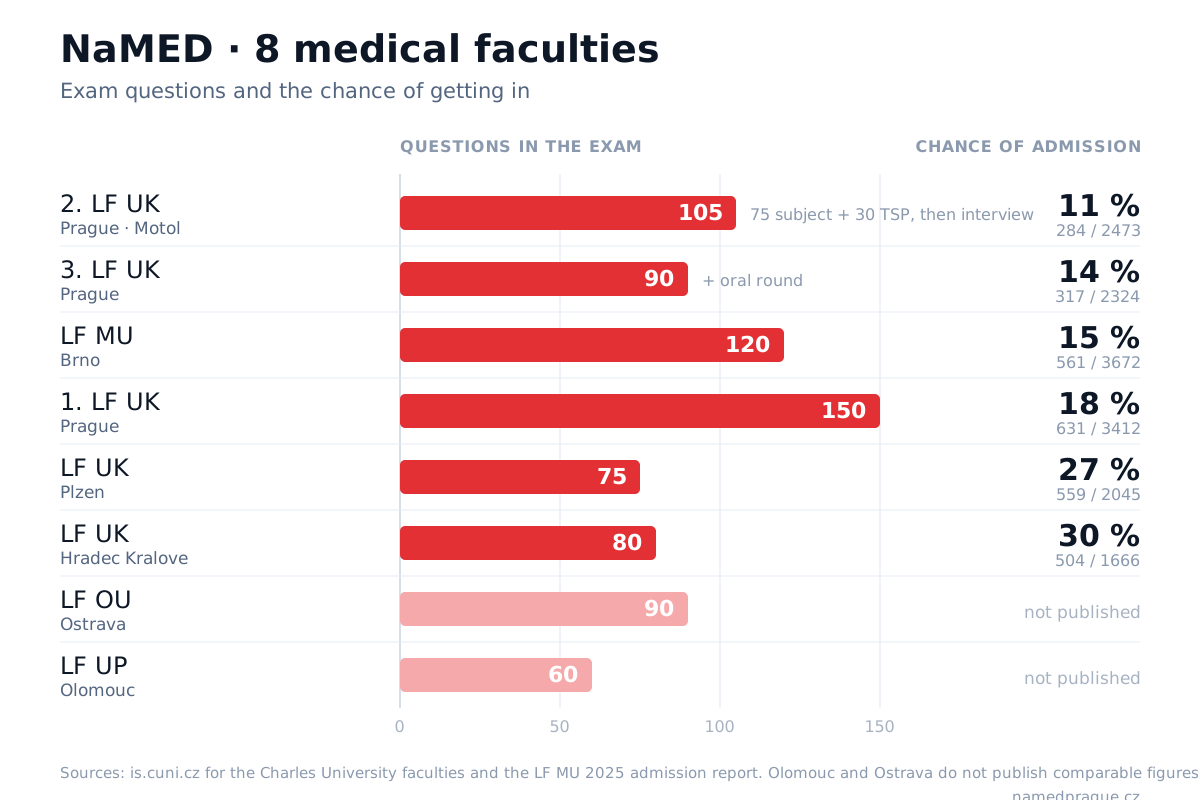
Without an initial diagnostic, it is easy to spend weeks on familiar chapters and miss a topic that regularly costs points. First check the full range, then allocate time based on real mistakes.
Where to begin
The diagnostic check shows three groups of topics: already mastered, needing revision, and not yet covered. Based on this result, you can create a schedule and avoid trying to study everything with the same depth.
- Check the starting level in each subject.
- Divide topics into required, weak, and recurring.
- Build a preparation calendar with tests after each block.
- Gradually switch vocabulary and tasks into Czech.
- At the end, move on to mock exams and error analysis.
Biology: understanding processes and connections
For medical entrance exams, it is not enough to know a term. You need to connect cells, tissues, organs, physiology, genetics, and metabolism, and understand what changes when a process is disrupted.
Genetics, anatomy, physiology, and cell biology need regular revision. After the explanation, solve a test, return to the mistakes after a few days, and check whether you can explain the process in your own words.
Chemistry: reaction logic and biochemistry
In chemistry, you need to know the conditions of reactions and see the links between organic chemistry, biochemistry, acids, bases, amino acids, and calculations. A simple list of formulas is not enough for this.
After a short explanation, solve a series of tasks and write down repeated mistakes. When the student understands the course of a reaction, they do not have to memorize every example as a separate exception.
Physics: an algorithm for calculation problems
In physics, one sequence of steps helps: read the problem, write down the data, choose the formula, convert the units, and check the result. This algorithm saves time and reduces the number of random mistakes.
The most common difficulties appear in mechanics, electricity, thermodynamics, optics, and tasks where you need to choose the right approach quickly. Physics is best prepared in small, repeatable blocks: theory, an example, several tasks, error checking, and later repetition.
Czech in the tasks
Even a strong student loses points if they read Czech task wording slowly. Terms and formulations should be introduced with each topic: hear the explanation, read the question, and answer without constant translation.
After admission, the same language will be needed in lectures, seminars, textbooks, and communication with teachers.
What a strong study plan looks like
A workable weekly cycle looks like this: new topic, tasks, short test, feedback, and repetition. At NaMED, materials in Online Academy and mock exams are added to lessons, so progress is visible through scores and types of mistakes.
By the exam, the student should be able to solve a question within the given time and understand which topics still need revision.
What to check at the start of preparation
| Biology | Cell, genetics, anatomy, physiology, metabolism, ecology, and evolution. Not only terms are important, but also cause-and-effect connections. |
|---|---|
| Chemistry | General chemistry, calculations, acids and bases, organic chemistry, biochemistry, amino acids, reactions, and recognizing patterns. |
| Physics | Mechanics, electricity, thermodynamics, optics, units of measurement, work with formulas, and timed calculation problems. |
| Czech language | Terms, question wording, instructions, names of processes, and the ability to read a test quickly without constant translation. |
| Exam skill | Timer, answer strategy, working with similar options, attention, stress resistance, and revisiting mistakes. |
How to plan 9 months
The academic year gives you time to cover the syllabus, revise difficult topics, and get used to the entrance-exam format. One workable schedule is:
- Months 1–2: diagnostic check, basic topics, study rhythm, terminology vocabulary, and the first test in each subject.
- Months 3–5: in-depth subject work, tasks, diagrams, revision, and the first mixed tests.
- Months 6–7: transition to faculty-specific formats: number of questions, timing, penalties, oral elements if there are any.
- Month 8: full mock exams, mistake table, priority revision, and training weak subjects.
- Month 9: final review, exam-day strategy, documents, interviews, and calm fine-tuning of the result.
Biology: how to study so you do not forget
Biology is extensive, so it is risky to study it by reading alone. It is better to build each topic in three steps: first understand the process, then draw a diagram or a short outline, and then solve tests and return to mistakes after a few days. For example, genetics cannot be covered by just one look at the rules: you need to solve problems, spot typical traps, and understand how the questions are phrased in Czech.
A good indicator of readiness is when the student can explain the topic in simple words and then solve test questions without help. If they recognize the term but cannot explain the connection, that is not yet exam level.
Chemistry: where points are most often lost
In chemistry, the illusion of knowing is often the problem. The student has seen the reaction but does not remember the conditions; knows the formula but makes a calculation error; understands organic chemistry separately from biochemistry but does not connect them. That is why chemistry requires regular practice and strict review of mistakes.
We recommend keeping a separate list of reactions, tasks, and terms where mistakes repeat. If the student makes a mistake once, that is normal. If the mistake returns a third time, it is no longer an accident but a topic for a separate mini-block.
Physics: how to remove fear of problems
For most tasks, a clear sequence is needed: identify the type, write down the data, choose the formula, check the units, and only then calculate. Errors often begin at the moment when the student looks for the answer option without understanding the problem statement.
Short daily tasks are especially useful. Five tasks a day with review give more than one big block every two weeks, after which the student forgets the algorithm again.
Checklist for strong preparation
- Every topic has a date of first study, a date of revision, and a test after revision.
- Mistakes are divided by cause: did not know the topic, did not understand the Czech wording, rushed, miscalculated, or ran out of time.
- The student trains on tasks that match the format of the selected faculties, not only on school exercises.
- Czech terminology runs alongside the subjects from the first month.
- Mini mock tests come after each block, and full timed exams begin 8–12 weeks before the entrance exams.
FAQ
Which subject is the most important?
You cannot choose just one. At most medical faculties, biology, chemistry, and physics are tested, and the final result depends on balance. Strong biology does not fully compensate for poor physics if the faculty format gives physics significant weight.
Can you prepare using only past tests?
No. Without reviewing mistakes, tests only show the current score. After each attempt, you need to identify the weak topic, revise it, and check again with new tasks.
When should mock exams start?
Mini mock tests can start after the first blocks. Full mock exams are best introduced closer to the final stage of preparation, when the student has already seen most of the syllabus.
What to read next
Official sources
We compared the subject blocks with the current requirements of medical faculties, where the combination of biology, chemistry, and physics most often appears, but the number of questions, timing, and grading differ.