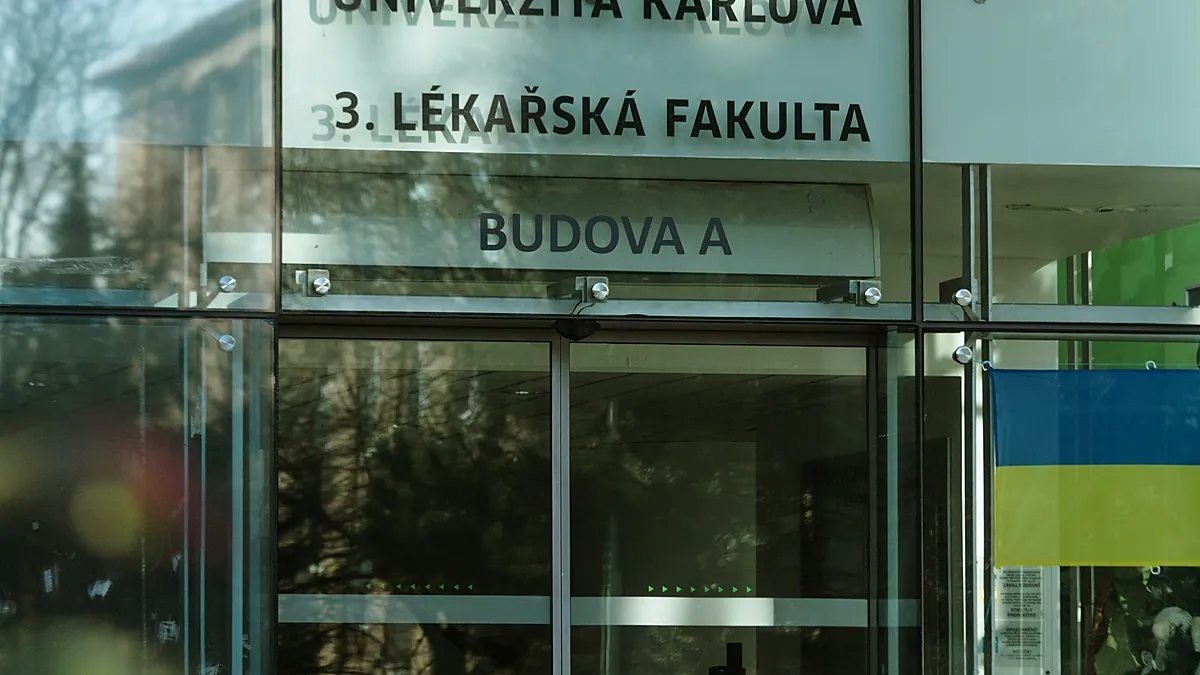
Reviewed by the NaMED editorial team: 24 August 2026. Admissions requirements change every year, so always check the dates and documents on the faculty’s official page before applying. Below is a practical guide: format, risks, and preparation strategy.
Short answer: admission to 3. lékařská fakulta Univerzity Karlovy
The 3rd Faculty of Medicine of Charles University is a good fit for students who are drawn to integrated medicine and problem-based learning. Admission has two stages: a written test in three subjects and an oral interview with a popular-science text, motivation, and independent reasoning.
3. lékařská fakulta Univerzity Karlovy: key facts
| City | Prague, Vinohrady, connected with FN Královské Vinohrady. |
|---|---|
| Program | Všeobecné lékařství, 6 years, full-time, title MUDr. |
| Chance of admission | 14% - 317 admitted out of 2,324 applicants (Charles University data for the previous academic year). |
| Application 2026/2027 | Application by 28 February 2026, fee 940 Kč. |
| Exam 2026/2027 | 1st stage 13 June 2026, 2nd stage 16-17 June 2026. |
| Written test | 90 questions: 30 each from biology, chemistry, and physics. |
| Answer format | 4 options, one correct answer, maximum 90 points. |
| Time | 3 hours for the written test. Calculators, tables, and other pomůcky are not allowed. |
| Oral stage | Interpretation of a popular-science text, discussion, motivation, independent judgement, communication skills. |
| Application fee 2026/2027 | Czech- and English-taught programmes: CZK 940 per application. |
How admission works
- 3. LF checks not only memory, but also the ability to think like a future medical student. This is already clear from the program description: the faculty emphasizes integrated teaching, a problem-based approach, and clinical thinking.
- The written test is easier to understand in structure than at 2. LF: 30 questions per subject, one correct answer. But advancing to the second stage requires a stable score across all three subjects.
- The oral part is not another subject exam. It tests work with an unfamiliar popular-science text, the logic of a presentation, discussion, overall maturity, and motivation.
- When preparing for 3. LF, it is especially important to read medical and popular-science texts in Czech, learn to retell them without notes, and answer follow-up questions.
- The faculty does not offer dentistry in the same sense as some other medical faculties; the goal here is general medicine.
How to prepare
- Prepare for the written test in the classic way: biology, chemistry, physics, then regular mock tests with 90 questions.
- At the same time, train the oral part: retelling an article, answer structure, arguments, ethical dilemmas, and a motivation interview.
- Read Czech texts about medicine, biology, public health, and scientific progress.
- Learn to speak briefly and logically: in the interview, clear thinking matters more than a long speech.
- In the final months, do simulations of the two-day exam: the written test plus an oral review the next day.
Who the faculty is suitable for
- The student likes modern medicine, interdisciplinarity, and discussion of clinical problems.
- They have the potential for oral communication in Czech or are ready to develop it actively.
- The student is not afraid of interviews and can reason, not just reproduce facts.
- They need a strong Prague faculty, but with a different style of teaching than at 1. LF.
Risks for an international applicant
- Ignoring the oral part is the main mistake. It cannot be prepared for well in a few days.
- Weak reading in Czech makes it harder to work with a popular-science text.
- If a student prepares only for the “one correct answer” and does not practice explaining their thoughts, they may lose points in the interview.
- 3. LF requires separate preparation for the interview and work with a popular-science text; a random backup application does not work here.
Mini checklist before applying
- Check the current admissions year on the faculty’s official page: deadlines, application fee, exam date, and test format.
- Verify which subjects are included in the exam at this faculty: Olomouc is an exam of concentration. 60 questions in 60 minutes mean the student must read Czech wording quickly and not get stuck on individual tasks.
- Prepare recognition of foreign education, translations, proof of Czech language, and personal documents in advance.
- Take a mock exam with the number of questions, timer, and grading rules of the chosen faculty.
- Check a backup plan: 2-3 more faculties that fit the format, deadlines, and the student’s actual level.
How NaMED helps here
For 3. LF, we add regular oral practice to biology, chemistry, and physics: retelling a popular-science text, committee questions, ethical topics, and motivation. The student practices reading the material quickly, identifying the key points, and calmly explaining their idea in Czech.
Frequently asked questions
Is the test or the interview more important at 3. LF?
First you need to pass the written screening, so the test is critical. But after advancing to the second stage, the interview becomes a full part of the result.
Do I need to be able to speak medical Czech?
Yes. Not necessarily like a doctor, but the student should understand a popular-science text and explain their thoughts in Czech without panic.
What kind of student is a good fit for 3. LF?
Someone who combines subject knowledge with communication, curiosity, and a willingness to think about medicine more broadly than just as a set of test questions.
Official sources
The links lead to official faculty pages and documents. Check the conditions for your academic year before submitting the application.